A First Visit to a Community Exhibition Without Rushing It
A first visit to a community exhibition feels easier when you choose a route, read labels selectively, and notice how the displays guide your attention.
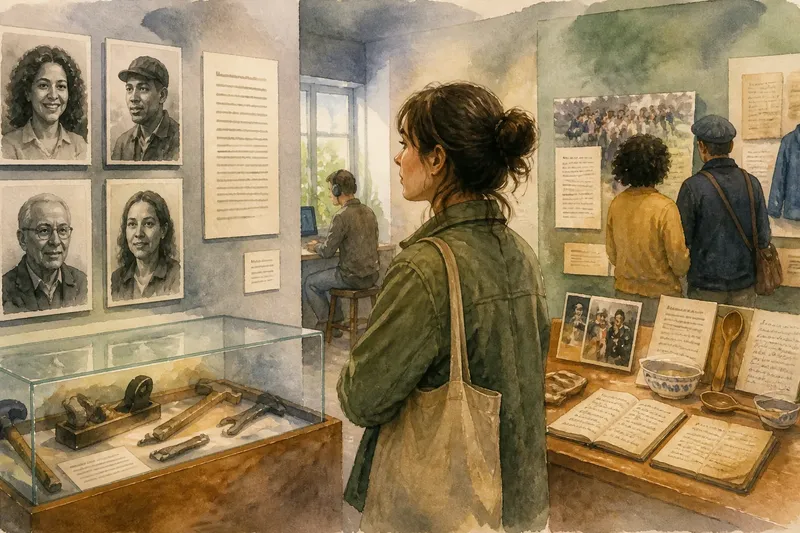
A first visit to a community exhibition is easier when you choose a route instead of trying to take in every photograph, object, and label at once. Start by noticing how the room is arranged, then let your attention settle on one section.
Choose a route through the exhibition
Community exhibitions may combine photographs, handmade objects, recorded memories, posters, and personal documents. Their variety can make the room feel like a queue of things you are supposed to inspect.
Pause near the entrance and look for the broad layout: clusters of displays, a central table, a listening station, or a clear path toward the exit. Pick one section that catches your eye, then follow a nearby link—a caption, shared subject, or group of related objects—if you want to continue.
Say you enter a neighborhood exhibition with a wall of portraits, a case of tools, and a table of handwritten recipes. You begin with the portraits, then follow a caption that points to the recipes; the result is a visit shaped by your interest rather than a forced march around the room.
It is not worth trying to read every label or photograph every object. A quick scan can help you choose, but racing from case to case leaves little room to notice the details that hold your attention.
Use labels to learn what objects cannot say alone
Labels do different jobs. An introductory panel may explain the exhibition’s subject, while an object caption can name a maker, describe where an item came from, or explain why it appears in the display. A quotation or memory gives one person’s account, not necessarily a complete explanation.
Read the opening panel if there is one, then choose captions beside objects that interest you. Give extra attention to text that adds context you could not get from the object’s appearance. The remaining labels can wait.
Notice whose names appear, how contributors are described, and whether the label distinguishes a personal recollection from other kinds of information. Those choices reveal how the exhibition credits people and presents knowledge.
If a term is unfamiliar, look for clues in nearby material or ask a host if the word matters to your understanding. You do not need to decode every phrase before moving on.
Notice how the exhibition brings different voices together
A community exhibition can share experiences without speaking for every person in a neighborhood. One contributor’s memory may be vivid and valuable while still belonging to that person alone.
Look for who is identified as a speaker, how contributions are described, and whether the room brings together different perspectives. A disagreement, a change in viewpoint, or a gap in the material can all affect how the exhibition presents belonging.
Consider who is easiest to encounter: whose face appears in a prominent photograph, whose words receive a large panel, and whose work is explained mainly by someone else. These details can help you understand the exhibition’s point of view without demanding an instant verdict.
Read an object through its neighbors and its caption
A garment, kitchen utensil, or faded event flyer may seem ordinary on its own, then take on added context beside a photograph or a contributor’s account. Notice its materials, placement, neighboring objects, and label before deciding what connection the display invites.
Imagine you see a jacket with a repaired sleeve beside a photograph from a neighborhood gathering. You notice the repair and the placement, read the caption, and learn that the jacket belonged to a volunteer shown in the picture. You can now describe the connection the exhibition provides without assuming how often the jacket was worn or what the repair meant to its owner.
When several objects appear together, consider what the arrangement asks you to notice: a shared place, use, owner, or color. The grouping may suggest a connection, but the caption or contributor’s account may explain it more clearly.
Follow posted guidance and make space for others
Check signs before touching objects, taking photographs, recording audio, or using a listening station. If instructions are not clear, ask a host instead of guessing; privacy and access needs can vary between exhibitions.
Give other visitors room to read or listen, and step aside when you are finished. If someone shares a personal memory, listen without pressing for details they have not offered.
Notice the available ways to engage, such as seating, a clear route, large-print text, or captions for audio. If one format does not work for you, ask whether another is available.
Which questions help you read a community exhibition?
How long should I spend at each display?
Stay long enough to notice what caught your attention and read any context that changes your understanding. Move on when you are ready; there is no required pace or full-room quota.
Should I ask a volunteer about an object?
Yes, if a host is available and your question is open-ended, such as asking how an object fits into the exhibition. The host may not know every contributor’s intention, so treat the answer as helpful context rather than the only possible reading.
What if I recognize someone or a place?
You can note the connection for yourself, but avoid sharing someone else’s private story in the room or online without permission. Ask a host whether the exhibition offers a way to contribute relevant context.
Is it rude to leave before seeing everything?
No. You can leave when you are ready, even if you have seen only part of the display. A focused visit can leave you with more room to notice what mattered to you.
Leave with a question you can answer later
Before you go, name one detail you want to remember and one question the exhibition leaves open. You might wonder who contributed an object, why two accounts differ, or what the display cannot show.
That brief pause gives a first visit to a community exhibition a useful shape without turning it into homework. For a return visit, carry forward that specific question; it can help you choose what to look for next time, or what to ask a host.