How to Read a Painting Without Looking for One Correct Answer
Learn how to read a painting by tracing its composition, visual patterns, and material choices, then build a thoughtful interpretation without forcing one answer.
How to read a painting begins with noticing how the image guides your eye, not with guessing a hidden answer. A red chair under a dark window may feel lonely, inviting, or simply striking; the arrangement and the marks on the canvas give you better grounds for exploring why.
Interpretation is not a contest to uncover a secret. Look at the painting as a made object: where it directs attention, what it repeats or disrupts, and how its visible choices shape your response. That approach gives you something specific to discuss, even when the work stays ambiguous.
Follow the painting’s visual path
Notice where your eye lands first, where it moves next, and where it stops. A bright face against a muted background, a diagonal arm, or a doorway aligned with a figure can create a visual route through the scene.
Then look at the composition as a whole. A close crop or a small screen can hide relationships between figures and objects, so step back from a physical canvas or view the entire image before dwelling on a detail. The placement of an empty chair may matter because it faces a crowded table, not because an empty chair always means absence.
Look for patterns in color, shape, and mark-making
Instead of assigning a fixed meaning to a color, ask how it behaves in this particular painting. Does red appear in one small object or recur across the canvas? Does a dark area frame a figure, flatten the space, or pull attention away from the center?
Brushwork and material choices matter, too. Smooth, carefully blended surfaces can feel different from visible, broken strokes; thick paint may catch light in a way a digital image cannot show. These features do not translate into a single emotion, but they help explain the painting’s tone and visual rhythm.
Use titles and historical context as clues
A title can point toward a subject or complicate what you thought you saw. Read it alongside the image rather than treating it as a final explanation. A title such as “After the Rain” may shift attention toward weather or aftermath, while leaving open what the scene means.
Information about the artist, period, location, or original setting can clarify unfamiliar objects and conventions. Museum labels and collection notes are useful starting points, but check what they actually establish: a label may identify a sitter or event without settling the painting’s emotional effect. Be especially cautious about assigning beliefs or motives to people depicted from a culture you do not know well.
Build an interpretation from visual choices
A persuasive interpretation connects a claim to specific features of the painting. If you think a scene suggests waiting, point to the still posture, the uncovered table, or the way the figure faces a closed door. Then consider details that resist your reading, rather than quietly ignoring them.
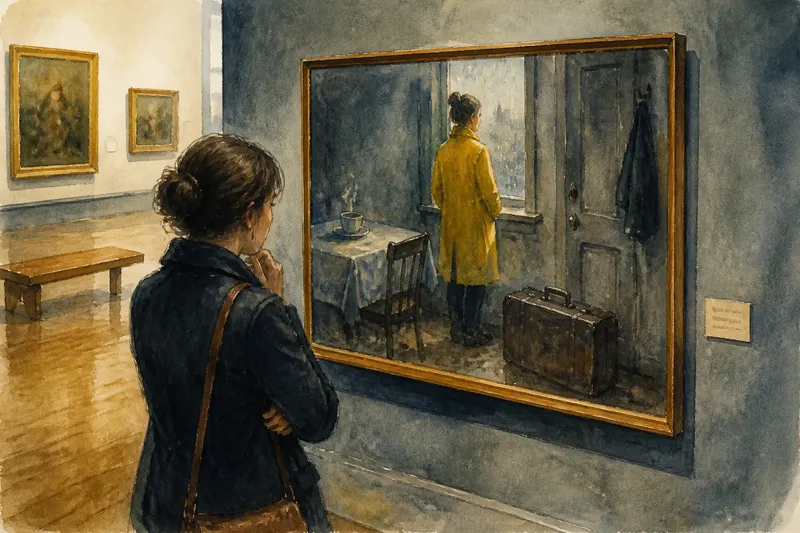
Imagine an invented painting with a figure in a yellow coat beside a rain-streaked window, a packed suitcase near the door, and a cup still steaming on the table. You first read the scene as departure because of the coat and suitcase; on a second look, the steaming cup makes the moment feel unresolved, as if the person has paused. The result is not a certain story about what happens next, but a more grounded reading of tension between leaving and staying.
It is not worth decoding every brushstroke as a private symbol or inventing a biography for an unidentified figure. Stay with details that are prominent, repeated, or connected to reliable context. When evidence runs out, name the uncertainty instead of decorating it with a confident backstory.
Choose a useful way to respond
In a class or group conversation, state your interpretation and point to the visual choices that led you there. Ask what another viewer noticed and whether that detail strengthens or complicates your account. The discussion becomes richer when people compare how the painting works, not just what they think it represents.
In a gallery visit, you do not have to settle on a meaning. Spend time with the whole composition, read the label if it adds useful context, and let an unresolved response remain unresolved. Online, treat color and texture as provisional clues because a screen can alter both.
What do readers ask about painting interpretation?
How do I start reading an unfamiliar painting?
Look at the full composition first, then follow the paths your eye takes through it. Notice repeated colors, shapes, gestures, and contrasts before deciding what they might suggest.
Does the title tell me what a painting means?
A title can narrow the possibilities or add a new angle, but it rarely explains every visual choice. Compare its suggestion with what the painting actually shows.
Can a painting have more than one good interpretation?
Yes, if each reading accounts for meaningful features and remains open to details that complicate it. A reading becomes less convincing when it depends on an unsupported story or overlooks a central part of the composition.
How should I interpret a painting online?
Use the full image to examine composition, but be cautious about color, texture, and small details that the display may distort. Treat those observations as tentative unless you can view the original or a reliable high-quality reproduction.
Let ambiguity sharpen what you notice
Ambiguity does not make a painting meaningless, and it does not require every interpretation to fit. A strong reading stays connected to the image’s composition, patterns, and material choices, while making room for details that point elsewhere.
When you read a painting, try naming the visual choice that changed your mind. That small habit turns uncertainty into attention: instead of asking which answer wins, you can explain what the painting makes possible to see.