The Place Name on the Map and the Story It Carries
Place names carry layers of language and memory. Learn to read maps, signs, and local usage carefully without mistaking a clue for a single origin.
A map label can hold more than one past. A river name printed in a language unfamiliar to you may survive from an earlier community, while a nearby street name reflects a later settlement or an official decision. Reading place names well means noticing these layers without turning a clue into a tidy origin story.
Start with the name you can actually see
Write down the form shown on the map, sign, transit display, or municipal website, including accents and unusual spellings. Names change as they move between spoken language, handwritten records, mapmaking conventions, and standardized signage. A dropped accent or altered vowel may reflect a practical spelling choice rather than a change in local pronunciation.
Then note where the name appears and what kind of place it labels. A label attached to a creek, neighborhood, mountain, or transit stop may have followed a different path from a street name. The same words can also refer to distinct places, so the feature itself matters.
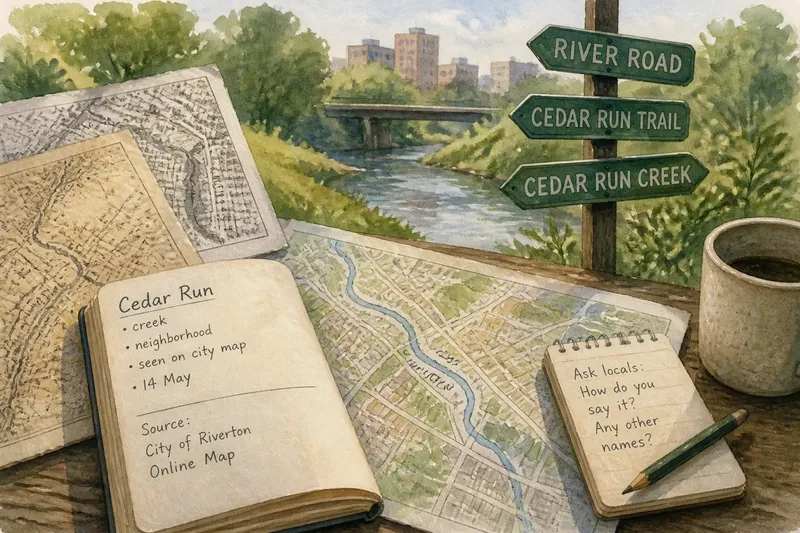
For a useful record, keep the exact spelling, the type of feature, and the source where you encountered it. That small discipline makes later comparisons clearer and keeps a familiar-looking word from quietly replacing the name on the ground.
Listen for the name beyond the map
Maps present names as fixed text; conversation reveals how people use them. Residents may pronounce a name differently from an announcer, use a shorter form, or distinguish between two places that official signage treats alike. Such variation can be ordinary local usage, not evidence that one speaker is wrong.
Pay attention to context as well as sound. Does a person use the name for the whole neighborhood, one corner, or a place with a particular social meaning? A name’s everyday reach may not match the boundary drawn by a map. Ask politely how people refer to the place, and listen without treating one person’s answer as the final word for everyone.
Pronunciation can also carry traces of languages that are no longer widely spoken in the area, or of a language adapted to the sounds and spelling habits of another. That possibility is worth noticing, but sound resemblance alone cannot identify a source. Similar syllables may arise independently, and a word heard through an unfamiliar accent can be easy to misparse.
Treat spelling as a clue, not a verdict
A place name may contain a recognizable word or suffix, but familiar pieces do not settle its history. A spelling might preserve an older form, represent a sound imperfectly, or result from a clerk or mapmaker writing down a name heard aloud. Later official forms can smooth out distinctions that mattered in the language from which the name came.
Look for variants in older maps, local directories, archived newspapers, or public records when those sources are available. Compare forms rather than selecting the oldest-looking one as automatically authentic. Records may disagree because the name was used differently by different groups, because spelling conventions changed, or because the feature itself shifted in meaning.
Also distinguish a place name from a translation or explanation printed beside it. A sign might give a current official name, a community-preferred name, a historical form, or a gloss intended for visitors. Those roles are related but not interchangeable.
Notice who named the place and who kept using it
Names can preserve the memory of people who lived in a place, but they can also reflect the authority of those who mapped, governed, or claimed it. A name honoring a person, describing a landscape, or marking a property may have entered public use through very different circumstances. The label alone rarely tells you who had the power to make it official.
Ask whose language the name seems to come from, whose accounts describe its use, and whose names appear on public signs now. These questions can point toward histories of migration, Indigenous presence, settlement, displacement, or renaming. They should remain questions unless reliable local sources support a more specific account.
It is easy to treat a surviving name as proof that a community’s memory has been fully preserved. In practice, a name may remain while knowledge of its meaning, pronunciation, or original users becomes harder to access. Conversely, a name that is absent from a standard map may still be meaningful in community speech.
Keep landscape and memory in the same frame
Some names describe visible features: a bend in a river, a steep slope, a stand of trees, or a crossing. Others refer to events, relationships, beliefs, or stories that are not obvious from the landscape. A name that appears descriptive to an outsider may have a more specific meaning in the language and knowledge of local speakers.
Compare the label with what the place is like, but do not assume the landscape explains the name by itself. A river may have changed course, a wetland may have been drained, or a landmark may no longer be visible. The name can outlast the feature that first made it seem apt.
Imagine you notice a creek called Cedar Run on a neighborhood map, though the banks are now lined with pavement and no cedars are visible. You record the exact label, check an older map for spelling or location changes, and ask a local library or historical society whether the name’s background is documented. The expected result is a clearer sense of what is known, what has changed, and what remains uncertain—not necessarily a complete origin story.
Separate a plausible reading from a documented history
When several explanations circulate, state them as possibilities and look for the kind of evidence each one would need. A family name might point to a former landholder, while a word in another language might point to an earlier description of the terrain. Both may sound convincing, but neither becomes established simply because it fits the spelling.
Useful sources can include local archives, historical maps, language resources, municipal naming records, and accounts from relevant community organizations. Each answers a different question. A map may show when a form appears in print; a language resource may clarify a word’s possible meaning; community knowledge may explain how a name is understood and used.
When a claim concerns an Indigenous name or another community’s language, give priority to sources produced by that community where available. Avoid repeating sensitive or sacred knowledge that has not been shared for general use. A careful account can say that the origin is disputed or not established in the sources you consulted.
Ask what the evidence can actually establish
Does a similar word prove where the name came from?
No. Similarity is a starting clue, not proof of descent or borrowing. Check for linguistic context, documented forms, and a credible account of how the name was used.
Can an official map settle the name’s history?
A map can show the form an institution adopted and sometimes when it appeared there. It usually cannot, by itself, establish who first used the name or what every community understood it to mean.
What if local speakers pronounce the name differently?
Record the variation respectfully and ask what the form means to the people using it. Do not turn one pronunciation into a test of belonging or assume that a difference signals error.
Is it useful to mention an uncertain origin?
Yes, if you make the uncertainty plain and distinguish an interpretation from a documented account. Leaving a question open is more accurate than presenting a neat story that the available evidence cannot support.
Leave room for more than one layer
A place can carry an older name, a later official form, and a community-preferred name at once. These forms may overlap, compete, or serve different settings. Recognizing that complexity does not require choosing a winner before you understand how each name is used.
For a short note about a name, identify the form, the source, and the evidence behind your interpretation. If you have only a resemblance or a local story without corroborating detail, say so plainly. There is little value in chasing a dramatic explanation through unsourced websites when the result is simply the same claim repeated in a circle.
The place name on a map is a useful invitation to pay closer attention: to spelling, speech, landscape, and the people who keep a name in circulation. A careful reading does not make every label transparent. It gives you a better question to carry into the place, and a more honest account of what its name may still hold.